

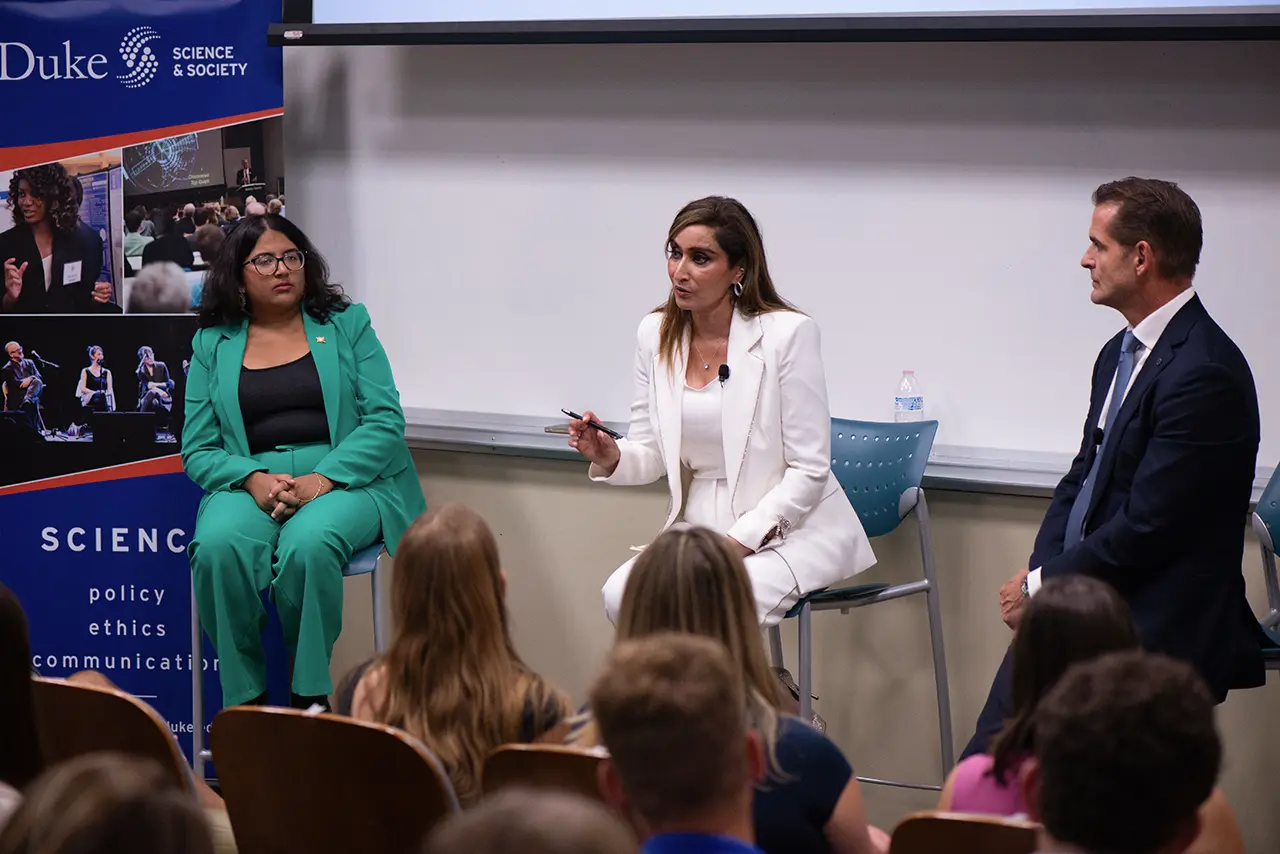
Ambassador Shefali Razdan Duggal’s visit to Duke Science and Society was perfectly timed with the first week of classes and provided incredible inspiration to students, faculty, and staff as we kicked off the academic year.
Born in India and raised in Cincinnati, OH from the age of 2, Ambassador Razdan Duggal’s unique upbringing and deep love for the United States was pervasive throughout her conversation with the Honorable Tommy Sowers, Ph.D. and Sophomore Computer Science student, Viveka Mehrotra. The ambassador shared invaluable insights into the world of politics and policy, navigating complex geopolitical situations, and – perhaps above all – leading with empathy and an innate desire to do good in the world.
The ambassador emphasized intentional leadership and the importance of showing up for underrepresented groups as one of the main themes throughout her visit. She began by sharing part of her personal history. How she grew up with a single immigrant mother who worked tirelessly to support her on two minimum-wage jobs and how integral the experience was to her development and understanding of the world. She shared a poignant personal anecdote about how she recognized at a young age that politics is pervasive in all our lives, recalling her first observations of Jimmy Carter and Ronald Reagan on TV, and noticing how their humble upbringings didn’t impede their paths to the presidency, but instead fueled them.
If there was one thing to take away from Ambassador Razdan Duggal’s visit, it was just how important it was to her that the next generation of leaders understand the value of emotional intelligence and relationship building. This is particularly important in relation to one’s ability to deeply empathize with individuals and entities of all types, including marginalized and historically underrepresented groups, those with opposing political viewpoints, foreign governments, and more.
Perhaps one of the clearest examples of this commitment was the weight she gave to being the first person of color to hold her position in the Netherlands. Understanding that what she did in this moment would shape the future for others to come, she asked the herself, “I’m the first person of color [as U.S. ambassador to the Netherlands], how’s the second one getting here?”
 Relationship Building and Emotional Intelligence
The ambassador emphasized how critical it was to lean in on the human aspect of her work. She recounted navigating competing interests between the U.S. and Dutch governments when it came to semiconductors and policy decisions around the shared political and security interests of both governments as it related to the transatlantic production and sale of these chips.
The CHIPS Act had just passed around the time she was confirmed to her diplomatic post and this rapidly expanded U.S. interests in semiconductors and organizations like ASML in the Netherlands. Ambassador Razdan Duggal stated that relationship building and emotional intelligence were key to her ability to rely on a staff of over 450 public servants at the U.S. embassy in The Hague. She dedicated as much time as possible to learning and becoming an expert on this and many other tech policy topics, often spending 90 hours a week keeping diplomatic priorities in check.
Her secret? Prepare, prepare, and overprepare. She highlighted how important it was to always be the most prepared person in the room, especially as a woman, a person of color, and an immigrant. She worked incredibly hard to ensure the success of her mission in the Netherlands and pointed out that success like this requires “doing the work” without bringing too much attention to how difficult it can be.
There were several audience questions about how the ambassador’s path led her to such a prestigious position within the U.S. government, and a recurring theme in her story was the importance of being your authentic self and staying true to your beliefs in every part of the work you do.
The ambassador closed out with what was arguably the perfect culmination of her attitude towards diplomacy and success. She repeated how important it is in her line of work to have a “why”, or a “north star”. Without this, she argued, the path to success is much more difficult.
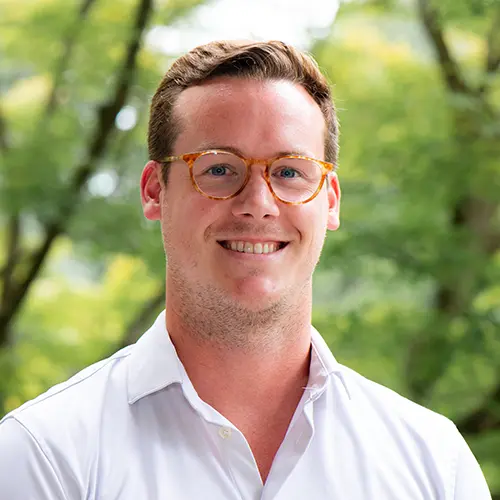
It was an absolute pleasure to have the opportunity to meet Ambassador Shefali Razdan Duggal during her visit to Duke Science and Society. As someone who lived and worked in the Netherlands around the same time as the Ambassador, it was a full-circle moment for me to meet her here at Duke and better understand the impact of having dedicated, empathetic leaders to bridge the gap between the competing interests of even our closest allies. The ambassador’s focus on leading with empathy and always being prepared resonated deeply with me, and I would go so far as to say that I’m confident the Ambassador’s Dutch counterparts would say much the same.
William Bishop is an MA candidate focusing on tech policy and ethics at Duke Science and Society. He lived and worked in the UK and the Netherlands on a highly skilled migrant visa from 2020-2024 and held several product development roles at Zoom and Miro during this time. These experiences gave him firsthand insight into the complex ethical and policy challenges global tech companies face, particularly around data residency, regional R&D practices, and the responsible use of AI.