
Senior Fellow, Duke Initiative for Science & Society
Science and the Public Certificate Director
Associate Professor of the Practice, Social Science Research Institute
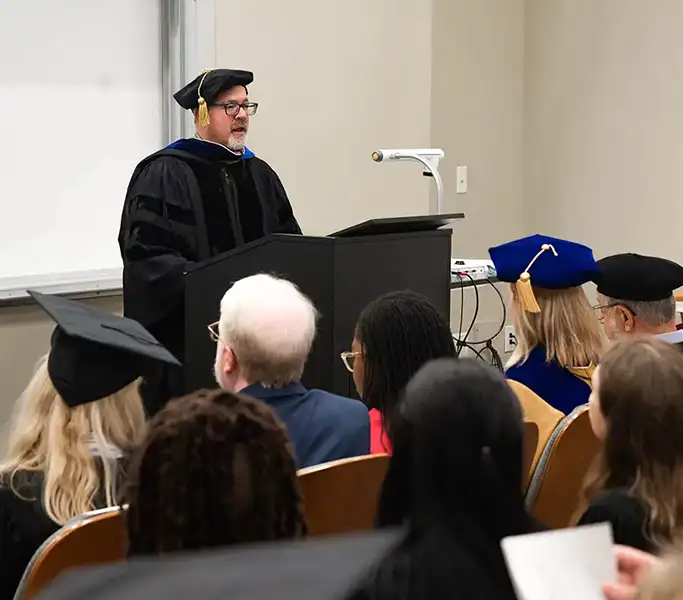
Misha Angrist has taught Duke undergraduate and graduate courses since 2006. These have included have included classes in genome sciences and policy, science writing, scholarly writing, patient advocacy, and human genetics. He has been a Duke faculty member since 2008. He directs undergraduate studies in the Initiative for Science & Society, whose offerings have included the Science and the Public Certificate (2017-2027) and the First-Year FOCUS cluster on Science and the Public (2018-2025).
Angrist serves as a faculty advisor for students in the MA in Applied Ethics & Policy program and has been a thesis advisor to students in Public Policy, International Comparative Studies, Philosophy, and Graduate Liberal Studies. He has led and co-led science writing and science communication workshops.
In his work, he explores the intersection of biology and society, especially as it relates to the governance of human participation in research and medicine. As a participant in Harvard’s Personal Genome Project, he was among the first people to have his entire genome sequenced and publicly shared. He chronicled this experience in his book, Here is a Human Being: At the Dawn of Personal Genomics (Harper). He is currently at work on a book about past, present, and future challenges in treating rare inherited metabolic disease.
M.F.A. Writing and Literature
Bennington College, 2001
Ph.D. Genetics
Case Western Reserve University, 1996
M.S. Genetic Counseling
University of Cincinnati, 1990
B.A. Indiana University at Bloomington, 1985
BIOETHIC 602: Research Ethics and Policy
SCISOC 256: Science and Society
PUBPOL 196FS: Patient and Research Participant Activism and Advocacy
CRP 253: Research Ethics and Responsible Conduct of Research
To Name a Rare Disease, Flaming Hydra
It’s Science, Flaming Hydra
A Loud Suit of Armor, Flaming Hydra
The Perverse Legacy of Participation in Human Genomic Research, Undark Magazine
Let’s Bring the Informed Consent Process Out of the Shadows, Undark Magazine
“For the last several years I’ve been working on a book about how we’ve treated genetic diseases over the decades and why it’s been such a challenge. I’m focusing on a rare inherited metabolic disorder called “maple syrup urine disease.” It has that unfortunate name because affected patients’ urine emits a peculiar, sweet odor shortly after birth (for years this scent was the quickest path to diagnosis).”
“People with MSUD inherit two copies of a broken gene that leaves them unable to metabolize certain amino acids. Until the 1960s, they would die in infancy. But then researchers figured out how to keep them alive with nasty-tasting low-protein dietary formula. Later, some smart physicians and food scientists made the formulas both better-tasting and more nutritious.”
“And then in the early 2000s, we learned essentially by accident that a liver transplant would allow MSUD patients to eat a regular diet. But of course, liver transplants are expensive and carry their own risks, not least of which is a lifetime on immunosuppressive drugs. Now we’re on the cusp of gene therapy, which could potentially cure the disease. But even though the science is up to the task, the market is not: pharma companies don’t want to invest in one-and-done treatments for diseases that only affect, at most, a few hundred people a year.”
“For me the book is really taking this one disease as a lens through which to understand both the remarkable scientific progress we’ve made but also all of the remaining technical and policy challenges. It is both a celebration and an indictment of genetic medicine.”
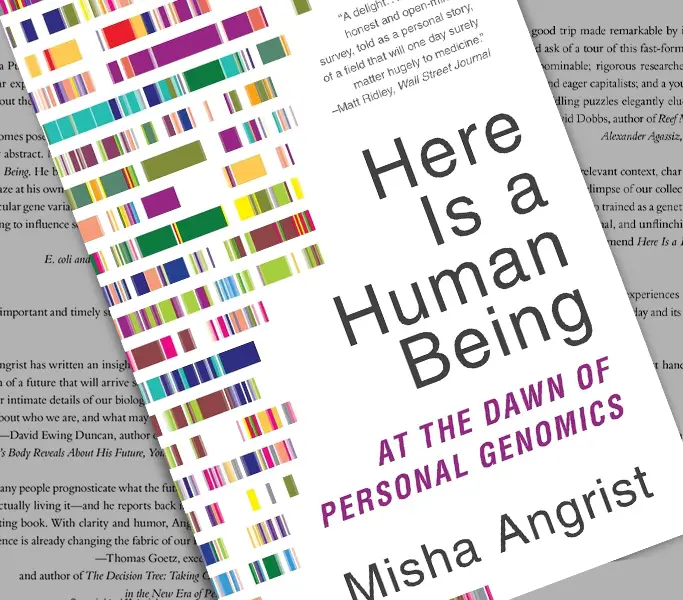
In 2007, Misha became the fourth subject in the Personal Genome Project, George Church’s ambitious plan to sequence the entire genomic catalog: every participant’s twenty thousand–plus genes and the rest of his or her six billion base pairs. Unlocking the secrets of our genomes opens the door to understanding why we are the way we are and potentially fixing what ails us, from cancer and diabetes to obesity and male pattern baldness. But what exactly will happen to this information? Will it be a boon or just another marketing tool?
Here Is a Human Being is the first in-depth look at personal genomics—its larger-than-life research subjects; its entrepreneurs and do-it-yourselfers; its technology developers; and the bewildered physicians and regulators who must negotiate with it—and what it means to be a “public genome” in a world where privacy is already under siege.
Misha organizes and hosts the long-running science café “Periodic Tables” at the Night School Bar in downtown Durham, NC. Periodic Tables is an informal science gathering where invited speakers share interesting, relevant science with the general public in an engaging and interactive way.
Topics are far-ranging; from canine cognition to shark myths, and how we might halve premature death by 2050. All are welcome. Come join the community for drinks and some data!
(*Periodic Tables is now held at the Night School Bar in Durham)
“I should say first that I’m not a card-carrying bioethicist or social scientist. I’m someone who trained in human genetics and got distracted. Nearly 20 years ago, I became involved with the Personal Genome Project—I was among the first people to have their entire genomes sequenced and made public.”
“Going through that process, I found myself wanting to know more about the ethics and policy implications of being a patient and/or research participant. How do we enroll people in clinical trials? What kinds of promises do we make to them? How do we consent people to medical procedures when they’re under duress? Who gets access to our genomic information?”
“I find myself increasingly drawn to the work of John Warner, who for me is the writing teacher’s writing teacher. His recent book, More Than Words: How to Think About Writing in the Age of AI, is a powerful reminder that “writing is thinking.” Thus, despite the proliferation of large language models, I am more invested than ever in helping students become better writers and thus (I hope!), better thinkers. “
“It’s difficult to pick just one. It might be a cliché, but I think that those lightbulb moments we occasionally get to see in our students are the most gratifying for me. It might be when they get their minds around a new concept, come to appreciate some obscure bit of history, or decide to change the trajectory of their academic careers or future plans because of something that we’ve discussed in class or they’ve read about while working on a final project.”
“Writing is thinking, to be sure, but it’s also communication. And this is always my bottom line. When a student writes a paper or gives a presentation, I don’t want them to traffic in pedantic abstraction—I want them to tell a story. You spent all of this time diving deep into, say, the nature of science publishing, or a particular research misconduct scandal, or a new medical application of AI—show us what you learned! Show us not just the arcane technical and legal details, but show us the people and the places. Don’t alienate us with jargon and passive voice—invite us in and enchant us. This approach, I hope, might help us find our way back from the current anti-science moment.”
“I have a unit on my Research Ethics and Policy syllabus this fall entitled “What is Even Happening?” I don’t think it’s overly dramatic to say that the current administration is turning American science as we’ve known it since the end of World War II into something unrecognizable: canceling grants, firing massive numbers of people at the Department of Health and Human Services (especially CDC, NIH, and FDA), undoing longstanding vaccine policy, altering datasets, curtailing climate research and regulation, etc. I can’t predict the future, but like many I worry that the chaos, the delays, and the dismissal of evidence and expertise are going to cost lives. We are embarking on a radical experiment and I think we owe it to our students to try to help them understand how we got here as well as the implications and range of possible outcomes for American health and biomedical innovation.”
“Probably my awful dad jokes and my dark, unfailing ability to bring ants to the picnic.”
“Hanging out with my family, cooking, writing, playing the piano badly, or fussing over my fantasy football team.”
“I don’t need time. I need a deadline.”
– Duke Ellington

(and he promises not to bring ants)
The FLUNCH (faculty + lunch) program is designed to encourage student-faculty interaction outside the classroom. Through the program, undergraduates can invite their faculty and/or course instructors to a free lunch at one of many dining locations across campus.
