


Professor of English
Core faculty, Duke Science & Society
Robert Mitchell is Professor in English and former Duke University Director of the Center for Interdisciplinary Studies in Science and Cultural Theory (2011-2023). His research in literary studies has focused on late eighteenth- and early nineteenth-century intersections between science and literature.
His more sociological research has focused on contemporary relationships among biological materials, economics, and information processing technologies. His published work on the latter topic includes the co-edited collection Data Made Flesh: Embodying Information (Routledge, 2003), the co-authored monograph (with Catherine Waldby) Tissue Economies: Blood, Organs and Cell Lines in Late Capitalism (Duke University Press, 2006), the co-authored DVD-ROM Biofutures: Owning Body Parts and Information (University of Pennsylvania Press, 2008), the monograph Bioart and the Vitality of Media (Seattle, WA: University of Washington Press, 2010), and articles and policy pieces that have appeared in journals such as Science; Transfusion; Biosocieties; and Science, Technology, and Human Values. Several of those essay publications focused on national biobanks.
His most recent work has focused on artificial intelligence and “smart” technologies, and especially the ways that both sets of technology rely on population-level data. He is co-author, along with Orit Halpern, of the monograph The Smartness Mandate (2023).
Ph.D. Comparative Literature
University of Washington, 2001
M.A. History
University of California, Irvine, 1995
B.A. Comparative History of Ideas
University of Washington, 1994
ENG 890: Planetary Experiments
ENG 493: Facts: Literary, Scientific, and Political
ENG 890S.01/LIT 890S.04: Artificial Intelligence, Smartness, and Narratives of Learning
ENG 290S: What is Progress?
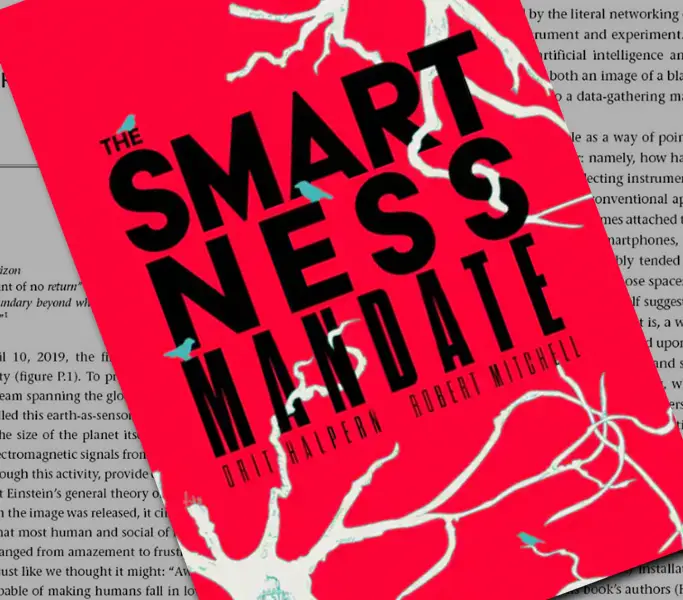
Over the last half century, “smartness”—the drive for ubiquitous computing—has become a mandate: a new mode of managing and governing politics, economics, and the environment.
Smart phones. Smart cars. Smart homes. Smart cities. The imperative to make our world ever smarter in the face of increasingly complex challenges raises several questions: What is this “smartness mandate”? How has it emerged, and what does it say about our evolving way of understanding—and managing—reality? How have we come to see the planet and its denizens first and foremost as data-collecting instruments?
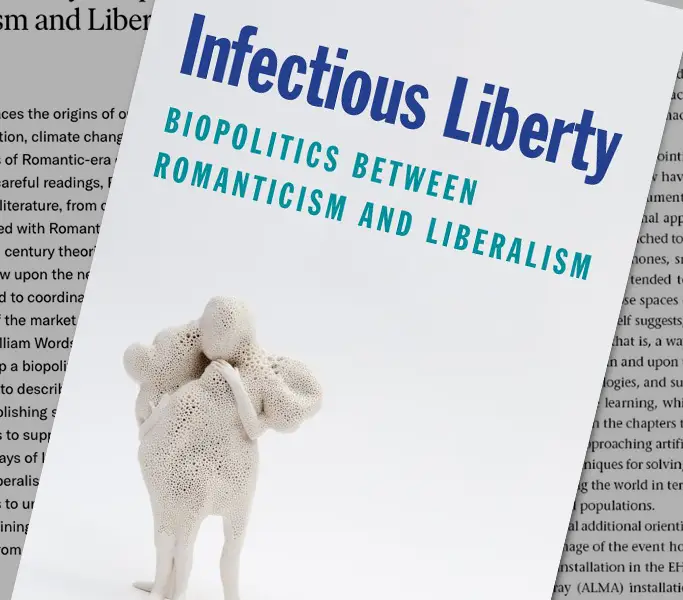
Infectious Liberty traces the origins of our contemporary concerns about public health, world population, climate change, global trade, and government regulation to a series of Romantic-era debates and their literary consequences. Through a series of careful readings, Robert Mitchell shows how a range of elements of modern literature, from character-systems to free indirect discourse, are closely intertwined with Romantic-era liberalism and biopolitics.
My interest in ethics and policy was first piqued by a graduate school course on “gift ethics,” and I found myself especially interested in the ways in which the ethic of donation in the medical arena—e.g., blood donation, organ donation, etc.—seemed to be troubled by the increasing tendency to treat biological gifts as the starting point for corporate property.
All things AI, ranging from how to treat AI in the classroom to the issues of how AI is increasingly replacing human expertise to hopes that AI can make it possible to link medical records currently housed in separate biomedical institutions to create huge-scale bioinformatic collections to the environmental toll of AI use.
Trying to figure out the place of “expertise”—especially university expertise—in a world in which that seems under attack, both from AI and at the level of political attacks on the university and its core values (e.g., free speech; autonomy of research; importance of the humanities; etc.)
The students—they are very smart and competent, and will do the work one asks of them. The fact that classes at Duke can be small also makes it easier to engage personally with students.
Enthusiasm and discipline-crossing interdisciplinarity (e.g., English professor who teaches in Science and Society; who writes about Frankenstein but also AI and contemporary smart technologies; and who publishes in Publications of the Modern Language Arts but also in Science).

The FLUNCH (faculty + lunch) program is designed to encourage student-faculty interaction outside the classroom. Through the program, undergraduates can invite their faculty and/or course instructors to a free lunch at one of many dining locations across campus.
